Handling, Cleaning and Packaging Micro Parts Without Damage

A micro part can be perfect at the final measurement and arrive scratched, bent, contaminated or short. A ⌀0.5 mm pin weighs a fraction of a gram, so it cannot be dropped, stacked or shaken like ordinary hardware. The handling and packaging steps are small in cost and large in risk, and they belong in the quote. For the inspection step that comes before packing, see the guide to measuring micro parts.
Where damage happens
Four moments cause most of the damage.
- Leaving the machine. Parts drop into a catch pan or bin, hit each other and pick up cutting fluid and chips.
- Cleaning. Strong agitation, wrong detergent or hot drying can dull edges, etch surfaces or leave stains.
- Handling between steps. Fingers, tweezers and trays can bend thin parts, leave oil or scratch polished faces.
- Packing and shipping. Vibration in a loose container turns every part into a tool for damaging the next one.
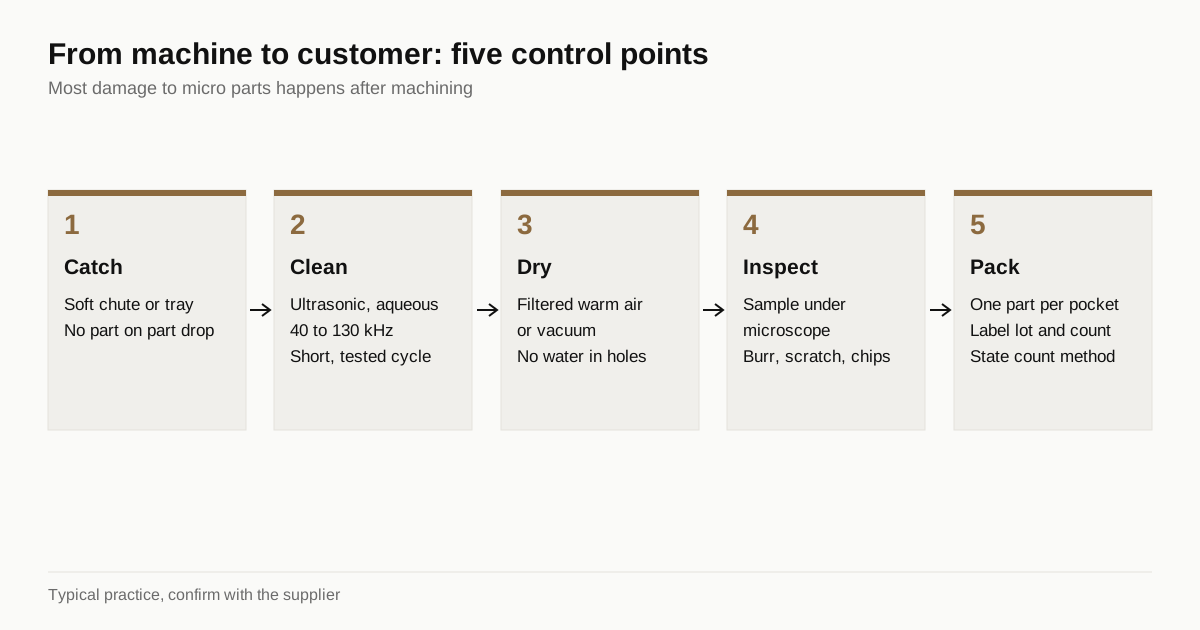
The sequence below shows a typical flow. Each step is a point where a shop can add a control.
Handling rules that matter
- Use the right tool. Fine tweezers with soft or ceramic tips, vacuum pens for tiny flat parts and gloves or finger cots for parts that must not carry skin oils.
- Catch gently. For Swiss-type lathes this means a soft catch tray or a part-collecting chute that does not let parts drop onto each other.
- Keep parts separate. Use compartments or pegboards during the process, not a single bin.
- Limit touches. Every handling step is a chance to damage. Fewer, better steps beat many careful ones.
- Do not squeeze. A tweezers grip on a thin tube or a wire will deform it, and the deformation will not show without measurement.
Cleaning
Micro parts carry cutting oil, coolant residue, chips and polishing compound. The cleaning method must remove them without changing the part.
| Method | Good for | Watch out for |
|---|---|---|
| Ultrasonic bath, aqueous detergent | Oils, chips in holes and threads | Erosion of soft metals, thin foil, bonded joints |
| Solvent or modified alcohol | Oils and fluxes, heat-sensitive parts | Residue, compatibility with plastics, flammability |
| Spray or flow rinse | Passages, manifolds, larger parts | Misses blind holes, needs good fixturing |
| Vapor degreasing | Heavy oils, complex shapes | Environmental limits, plastic compatibility |
| Final rinse in clean water | All aqueous methods | Water quality, spotting, corrosion if left wet |
Typical practice for orientation. Confirm the method with the shop.
Ultrasonic cleaning is the standard in micro machining because the cavitation reaches blind holes and thread roots. Typical bath frequencies run from about 40 kHz for general cleaning up to about 130 kHz for delicate parts, where higher frequency makes smaller, gentler bubbles. Soft metals, thin foil and fine wire can be marked by it, so test on a sample first and keep the time short.
Match the method to the contamination
Different residues need different cleaners, and one bath rarely does everything.
- Cutting oil and coolant. Alkaline aqueous detergents or modified alcohol remove them. Water-soluble coolants rinse away more easily than neat oils.
- Polishing and lapping compound. Often needs an ultrasonic step with a specific detergent and a fresh rinse, because compound is fine and sticks to surfaces.
- Plating salts and residues. Need an extended rinse in clean water, sometimes warm, to avoid spotting and corrosion.
- Fingerprints and light oils. Solvent or alcohol wipe, or a gentle immersion, for sensitive finishes.
Each step adds a rinse, and the final rinse decides the result. Shops use filtered or deionized water for the last one, because tap water leaves mineral spots on small parts.
Particles and static
Plastic trays and bags can attract dust and, on electronic parts, carry electrostatic charge. A tray can be anti-static, and parts can be packed in a clean area or a laminar-flow bench for particle-sensitive work. If a particle limit applies, say how it is measured, for example by a rinse and a particle count, and not only the cleanliness class of the room.
Drying and corrosion
A wet part is a risk. Water left in blind holes and threads causes spots and, on some alloys, corrosion. Typical options are warm filtered air, vacuum drying or oven drying at modest temperature, and an alcohol final rinse for fast evaporation. Plastics and bonded assemblies set the temperature limit.
Corrosion inhibitors on packaging paper or film can stain brass and copper alloys or leave a film on a sealing face. If the part is sensitive, say so. Do not assume a protective packaging is neutral.
Packaging choices
| Part type | Typical packaging | Why |
|---|---|---|
| Plain rugged pins, no critical surface | Small bags or tubes, counted by weight | Low cost, low damage risk |
| Threaded, sharp or polished parts | Foam or molded tray, one part per pocket | No part-to-part contact |
| Very small or delicate parts | Gel film box (silicone tacky film) | Holds each part in place by adhesion |
| Parts for electronics | Anti-static trays or bags | Controls electrostatic discharge |
| Medical or fluidic parts | Clean bags or trays, sealed, in a controlled area | Limits particles and re-contamination |
Typical practice for orientation. Customers’ quality systems may require specific materials.
Add a label with part number, revision, lot and quantity, and put a separate certificate or report in a clean sleeve. A mix-up of lots is easier to prevent than to untangle.
Counting
Counting by weight is accurate if every part is the same, but a missing part, a stray chip or a different batch can hide in a weight count. For parts that are expensive, regulated or traceable, count by tray position or vision system. Put the counting method in the order, along with how much shortage is allowed.
Hypothetical example
An order covers 2,000 stainless pins of ⌀0.6 mm and 8 mm length with a polished tip and a threaded end, used in a medical device. The first shipment arrives in a plastic bag. Under a microscope, 6 percent of the tips show scratches, and some threads carry chips.
A better setup is simple. The shop catches parts in a soft chute, cleans them in an ultrasonic bath with a short cycle, dries them with filtered warm air, inspects a sample under the microscope and packs each pin in a molded tray with 50 pockets. The tray costs a few cents per part, a fraction of the scrap cost of the first shipment. State the packaging in the RFQ and the shop can quote it, not discover it later.
What to put in the RFQ
- Cleanliness. The method, a particle or residue limit and the standard used.
- Packaging. Individual pockets, gel box, anti-static or bag, and any customer-specific format.
- Counting. By weight, by tray or by vision, and the shortage tolerance.
- Labeling. Part number, revision, lot, quantity and any traceability.
- Sensitive surfaces. Polished faces, threads and thin features that need protection.
- Inspection before shipping. Sample size and the method.
The buyer’s guide to micro machining explains how these lines fit into a complete request, and the tolerance and materials reference shows typical figures. When the packaging is defined, send an RFQ. Micropartz matches it with up to 3 shops that handle small parts carefully and replies within 24 business hours.
See also: ISO 14644 cleanroom classes for cleaning and packing micro medical parts.
Frequently asked questions
Can micro parts be shipped loose in a bag?
Only rugged shapes such as plain pins with no critical surface. Parts with threads, sharp edges, polished faces or thin features should ship in individual pockets or a gel film box. Loose parts rub and nick each other in transit, and the damage is smaller than the eye sees.
Is ultrasonic cleaning safe for micro parts?
Usually, with care. Cavitation removes oils and chips from holes and threads, but it can erode soft metals, thin foils and fragile wires, and can loosen a bonded joint. Shops set frequency, time and detergent to the part and test samples.
How are micro parts counted?
Small parts are often counted by weight, using the weight of a measured sample. That is accurate for identical parts and wrong if a few are missing or are different. For critical or expensive parts, counting is by tray position or vision system. State the counting method in the order.
What cleanliness level should I ask for?
It depends on the use. A mechanical pin may only need to be free of oil and visible chips. A medical or fluidic part may need a particle limit, a residue limit and a defined rinse. Name a standard or a test rather than a vague word like 'clean'.
Reviewed against
- Wikipedia: Ultrasonic cleaning
- ISO 14644-1, Cleanrooms and associated controlled environments, classification of air cleanliness by particle concentration
Numbers in this guide are typical values for orientation. The drawing, the material certificate and the matched shop set the real ones.
Get matched with a micro machining shop
Send your drawing once. We match it with up to 3 shops that fit the part, and reply within 24 business hours. Free for buyers.
Send an RFQ