Beryllium Copper and Phosphor Bronze for Micro Contacts and Springs
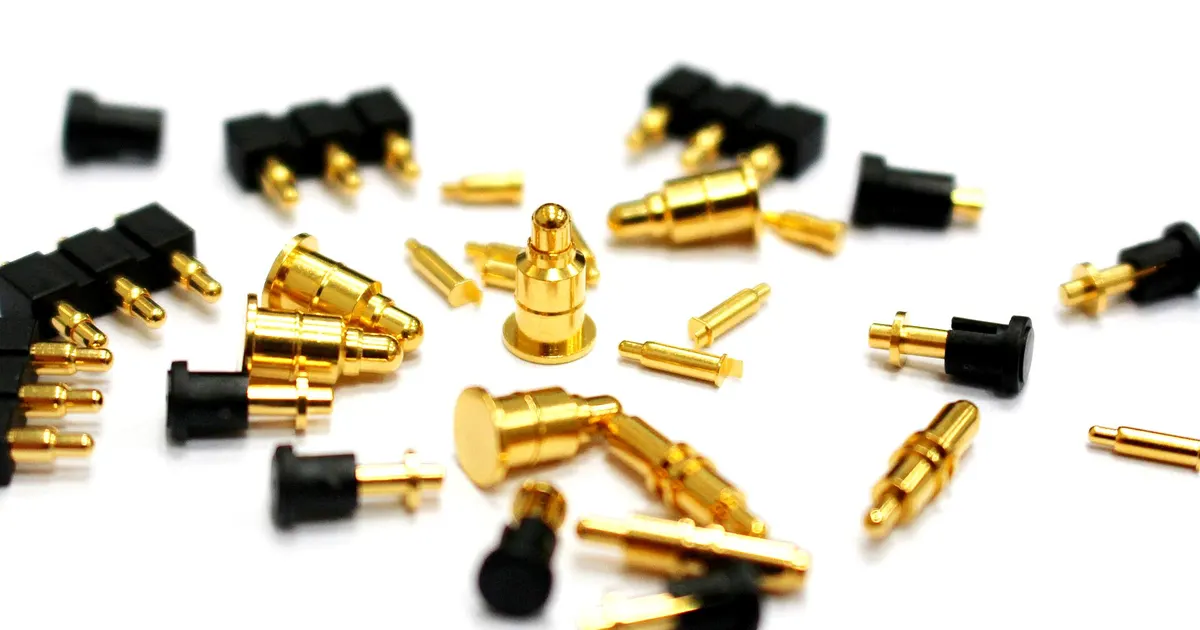
A micro contact is a spring that also carries current. The pin on a test probe, the clip in a connector and the contact finger in a switch all have to push with a steady force, thousands of times, without taking a permanent set, and pass current with low resistance. Two copper alloys do most of that work: beryllium copper and phosphor bronze. They are close on the drawing and far apart in strength, cost and safety. For other materials in this size range, see the guide to materials for micro machining.
The alloys
| Alloy | UNS | Typical tensile strength | Electrical conductivity | Machinability | Typical use |
|---|---|---|---|---|---|
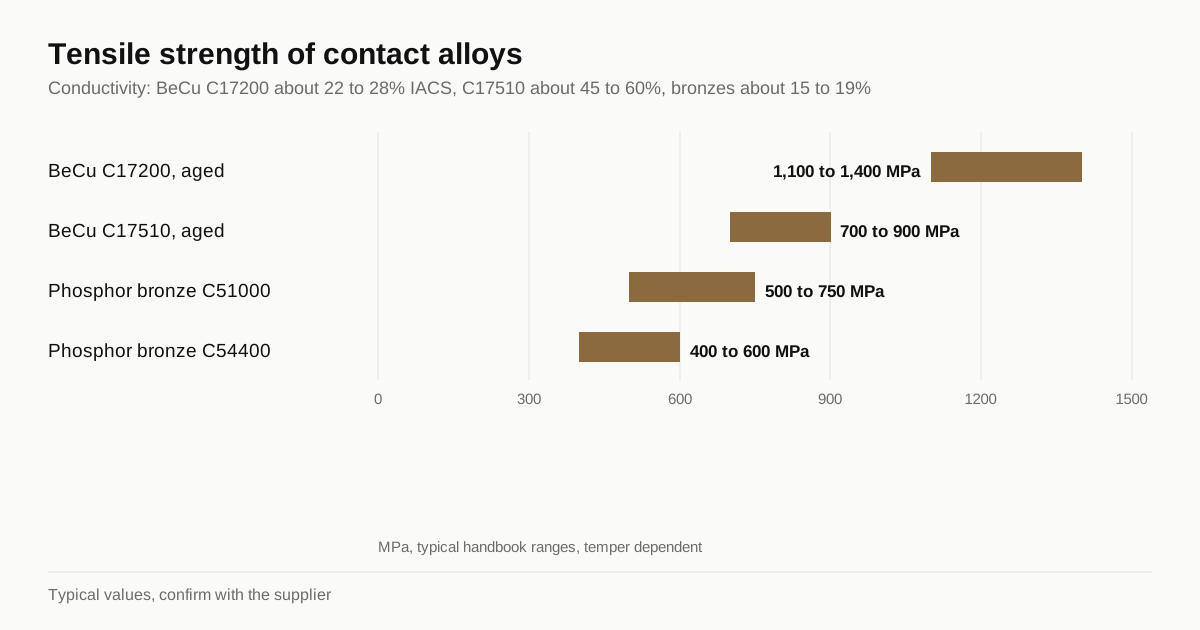
| Beryllium copper, high strength | C17200 | About 1,100 to 1,400 MPa aged | About 22 to 28 percent IACS | Fair to poor | Spring contacts, probes, connectors |
| Beryllium copper, high conductivity | C17510 | About 700 to 900 MPa aged | About 45 to 60 percent IACS | Fair | Current-carrying contacts |
| Phosphor bronze, 5 percent tin | C51000 | About 500 to 750 MPa, spring temper | About 15 percent IACS | Fair | Springs, bushings, contacts |
| Phosphor bronze, free-cutting | C54400 | About 400 to 600 MPa | About 19 percent IACS | Good | Turned contacts, sockets, bushings |
Typical handbook values for orientation. Temper and form change them. Check the standard and certificate.
Beryllium copper is the strongest. Phosphor bronze is easier and cheaper. Conductivity in IACS is relative to annealed pure copper at 100 percent, so neither alloy comes close to copper itself, and high-current contacts often use the high-conductivity beryllium copper grade or a plated or clad solution.
Heat treatment and size change
Beryllium copper gets its strength from precipitation hardening, not from cold work alone. It is supplied in the soft, solution-annealed condition, machined easily, and then aged at roughly 315 to 345 °C for two to three hours. The part gains strength, hardness and spring properties.
Aging changes size. The part contracts by about 0.1 to 0.2 percent, which on a 5 mm length is 5 to 10 μm and on a ⌀0.8 mm pin is about 1 to 2 μm. Flat or thin parts can warp slightly. For tight tolerances, shops measure after aging and plan the stock removal accordingly, or finish critical diameters by grinding after the heat treatment.
Phosphor bronze does not age harden. It is supplied in tempers that set its strength, from soft to spring hard, and is machined in that state.
Machining notes
| Topic | Beryllium copper | Phosphor bronze |
|---|---|---|
| Condition for machining | Solution-annealed, soft, then aged | As supplied, free-cutting grades are easy |
| Burrs | Moderate to large | Moderate, small in leaded grades |
| Tool wear | Moderate, harder tools in aged state | Low to moderate |
| Typical tolerance | ±0.005 mm after aging with allowance | ±0.005 mm |
| Safety | Beryllium dust and fume controls required | Normal shop controls, lead in C54400 |
Typical practice for orientation. Confirm with the shop.
For Swiss-type work, leaded phosphor bronze C54400 behaves like a free-cutting alloy and produces short chips. Beryllium copper cuts well in its annealed state but can build up on the tool and burr, so shops use sharp tools and steady feed. Leaded beryllium copper C17300 improves machinability but is less common. The guide to Swiss-type turning for micro parts describes how bar is fed and supported.
Beryllium safety
Beryllium is the reason not every shop will quote these parts. Solid beryllium copper is safe to handle. The hazard is airborne beryllium from dust, fine chips, fumes and some finishing operations, which can cause chronic beryllium disease, a serious lung condition. Workplace exposure limits are set in micrograms per cubic meter, far lower than for most metals. For example, the United States OSHA limit is 0.2 μg/m³ as an eight-hour average.
A shop that machines beryllium copper typically has local exhaust at the machine, wet cutting, HEPA filtration, controlled swarf handling, cleaning rules and training. Ask about this directly. A shop that has no program should not make the part, and buyers can also ask for the safety data sheet of the material and for a statement of controls. Beryllium-free alternatives, such as copper-nickel-silicon or copper-titanium alloys, exist where the application allows.
Spring design basics
Contact force comes from deflecting a beam or tine, and the design decides which alloy is needed. The stress in a bent beam rises with thickness and deflection, and the alloy must stay below its elastic limit or the spring takes a permanent set.
| Design question | Effect | Typical consequence |
|---|---|---|
| Thin tine, long and deflected a lot | Low stiffness, high strain | Needs high-strength alloy such as aged BeCu |
| Thick, short tine | High stiffness, low strain | Phosphor bronze may be enough |
| High temperature in service | Stress relaxation | BeCu holds force better than bronzes |
| Many cycles | Fatigue | Smooth surface, no burrs or tool marks at the bend |
Typical relationships for orientation. A spring calculation or test confirms the design.
Stress relaxation is the slow loss of contact force under constant deflection at elevated temperature. Beryllium copper relaxes less than phosphor bronze, which is one reason it is chosen for contacts that run warm. Tool marks, burrs and sharp corners at the bend start fatigue cracks, so the shop’s finishing matters as much as the alloy. If the contact is critical, give the shop the force and cycle requirements, not only the dimensions.
Plating and contact surface
Contacts rarely run bare. A typical stack is a nickel barrier layer of 1 to 3 μm and gold of 0.1 to 1 μm on the mating surface, or tin or silver on lower-cost designs. Plating thickness adds to the size on every surface. Plating also hides small burrs and scratches until the contact wears, so surface finish and burr limits belong on the drawing before plating, not after. The guide to deburring micro parts covers edge condition.
Hypothetical example
A spring-loaded test contact has a plunger of ⌀0.6 mm and 4 mm length, a tip radius of 0.1 mm and a contact force of 30 g at 0.5 mm travel, rated for 100,000 cycles. The plunger rides in a brass barrel with a stainless steel spring.
For the plunger a designer might choose beryllium copper C17200 for stiffness and wear, or free-cutting phosphor bronze C54400 if the loads are low and the cost matters. The shop machines the BeCu plunger soft, ages it, then finishes the tip diameter, and plates nickel and gold. The 0.1 to 0.2 percent shrink on a 4 mm length is a few micrometers, so it is within the length tolerance but must be included in the plan. If the production volume is 50,000 and the force allows, switching to C54400 would remove the beryllium controls, ease cutting and lower the price.
What to put in the RFQ
- Alloy and temper. For example C17200 TH04 to ASTM B196, or C54400 to the relevant standard.
- Heat treatment. Aging time and temperature, and whether dimensions apply before or after.
- Spring or force requirement. Force at deflection and cycle life, in case the shop proposes an alternative.
- Plating. Layers, thickness and tolerance before or after.
- Safety and certificates. Beryllium handling statement and material certificates.
- Edge and finish. Burr limit and Ra on contact surfaces.
The tolerance and materials reference lists typical figures. When the drawing is clear, send an RFQ. Micropartz matches it with up to 3 shops that machine copper alloy contacts at micro scale and replies within 24 business hours.
Frequently asked questions
Is beryllium copper dangerous?
Solid parts are safe to handle. The hazard is in dust, fine chips and fumes from machining, grinding, polishing and some heat treatment, which can cause chronic beryllium disease if inhaled. Exposure limits are very low, so shops need local exhaust, wet machining, filtration and training.
Why does the shop machine beryllium copper before aging?
In the solution-annealed condition it is soft enough to cut easily. The part is then aged at roughly 315 to 345 °C for a few hours to reach full strength. Aging changes size slightly, so critical features are finished or allowed for after it.
When is phosphor bronze enough?
For moderate spring forces, good fatigue life and lower cost, particularly in contacts, bushings and small springs. Free-cutting phosphor bronze such as C54400 machines much more easily than beryllium copper. Choose beryllium copper only when strength, stiffness or conductivity needs it.
Is there a beryllium-free alternative?
Yes. Copper-nickel-silicon and copper-titanium alloys approach beryllium copper in strength, and some contact designs use phosphor bronze or stainless steel springs. Each has trade-offs in conductivity, fatigue and forming, so confirm against your performance requirement.
Reviewed against
- Wikipedia: Beryllium copper
- Wikipedia: Phosphor bronze
- ASTM B196, Copper-Beryllium Alloy Rod and Bar
Numbers in this guide are typical values for orientation. The drawing, the material certificate and the matched shop set the real ones.
Get matched with a micro machining shop
Send your drawing once. We match it with up to 3 shops that fit the part, and reply within 24 business hours. Free for buyers.
Send an RFQ