303 vs 316L Stainless Steel for Micro Components: Machinability, Corrosion and Cost
Two stainless steels cover most micro parts. 303 is the free-machining choice. 316L is the corrosion-resistant, medical and fluid-contact choice. They look the same on a drawing that just says “stainless steel”, and they are far apart in price, burrs, cutting speed and where they can be used. Choosing between them early, and writing the grade and standard on the drawing, avoids a quote that has to guess. The guide to materials for micro machining puts both in context with other metals and plastics.
Composition and what it does
Both are austenitic stainless steels with about 17 to 19 percent chromium for the passive film. The differences are small in number and large in effect.
| Element | 303 (UNS S30300) | 316L (UNS S31603) | Effect |
|---|---|---|---|
| Chromium | 17 to 19 percent | 16 to 18 percent | Passive film, general corrosion resistance |
| Nickel | 8 to 10 percent | 10 to 14 percent | Austenite stability, toughness |
| Molybdenum | Trace to 0.6 percent | 2 to 3 percent | Pitting and crevice corrosion resistance |
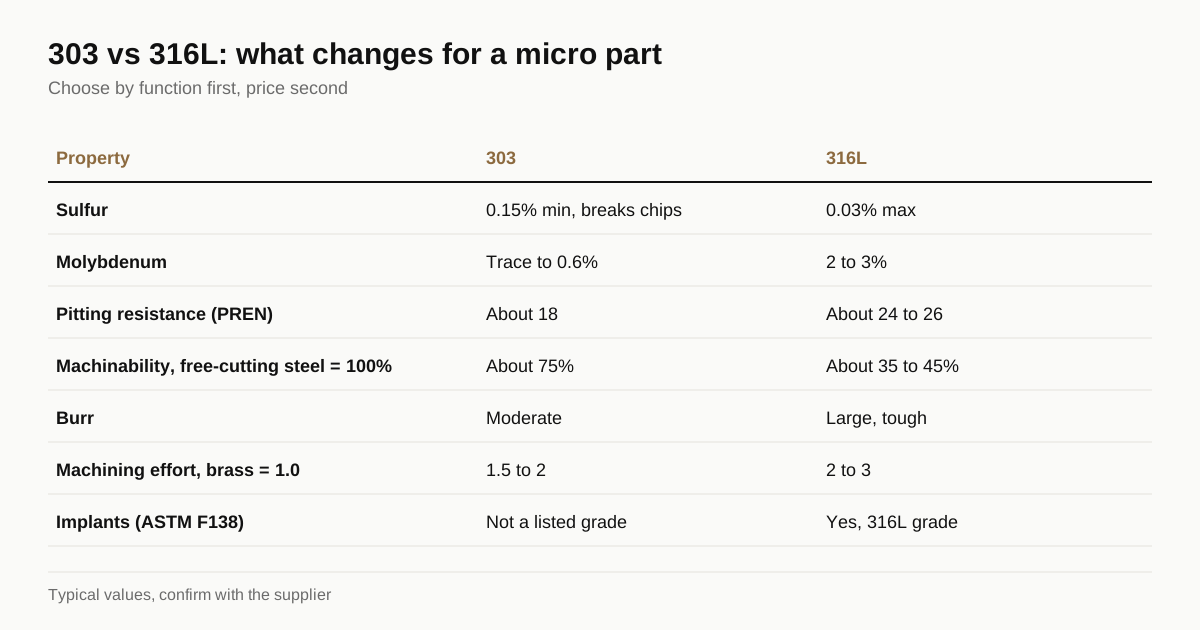
| Sulfur | 0.15 percent minimum | 0.03 percent maximum | Chip breaking in 303, weakness to pits |
| Carbon | 0.15 percent maximum | 0.03 percent maximum | Low carbon in 316L limits sensitization |
Typical standard ranges for orientation. The certificate and standard govern.
Sulfur is the key difference. In 303 it forms manganese sulfide inclusions that break chips and reduce friction. In 316L sulfur is held low to keep corrosion resistance and toughness, and the metal becomes gummy.
Machining behavior at micro scale
| Property | 303 | 316L |
|---|---|---|
| Machinability rating, relative to free-cutting steel | About 75 percent | About 35 to 45 percent |
| Chip form | Short, broken | Long, stringy, gummy |
| Burr size | Moderate | Large, tough |
| Work hardening | Low | High |
| Typical tolerance on turned diameter | ±0.005 mm | ±0.005 to ±0.01 mm |
| Relative machining effort, brass = 1.0 | 1.5 to 2 | 2 to 3 |
Typical values for orientation. Actual effort depends on geometry and quantity.
At ⌀0.5 mm the difference is easy to see. A 303 pin comes off a Swiss-type lathe with short chips and a modest burr. A 316L pin of the same shape needs lower feed, sharper tools and more deburring, and breaks more small drills and taps. The guide to micro machined part cost shows how this reaches the price.
Corrosion and where each can be used
Pitting resistance is often compared with the pitting resistance equivalent number, PREN, which is roughly chromium plus 3.3 times molybdenum plus a nitrogen term. By that measure 316L scores around 24 to 26 and 303 around 18, so 316L resists chlorides, saline fluids and cleaning agents far better.
The sulfide inclusions in 303 can also start pits, so a 303 part in a wet, salty or sterilizing environment may corrode where 316L would not.
| Application | 303 | 316L |
|---|---|---|
| Dry mechanical parts, general hardware | Good choice | Works, costs more |
| Indoor electronics, connectors, fixtures | Good choice | Works |
| Food contact | Depends on rules and surface | Typical choice |
| Marine or chloride exposure | Poor | Typical choice |
| Fluid paths in analytical and medical devices | Not recommended | Typical choice |
| Implants | Not permitted by implant standards | ASTM F138 grade, common |
Typical guidance for orientation. Confirm with your standard and regulator.
For implants and long-term body contact, the standards name 316L bar to ASTM F138 or other listed grades, with certificates and traceability. 303 is not among them. For non-implant medical instruments the rules vary, so check with your regulatory team before changing a grade.
Surface finish and passivation
Both grades are passivated after machining to remove free iron and restore the chromium oxide film. Passivation to ASTM A967 or a similar standard is common. On 303, passivation is not a guarantee against pitting because the sulfides are exposed at the surface, and shops sometimes use a gentler process to avoid attacking them. Electropolishing is common for 316L and removes 5 to 25 μm per surface, so the tolerance must allow for it. The separate guide on deburring micro parts covers edge effects.
Hypothetical example
A sensor pin of ⌀0.8 mm and length 12 mm was drawn in 316L out of habit. It sits inside a dry housing, has no body contact and sees no chlorides. The drawing calls for ±0.005 mm on the diameter and a burr limit of 20 μm at one cross hole.
A shop quoting both grades may find 303 cuts about 30 to 40 percent faster, gives a smaller burr and needs no extra deburring step, which together could reduce the price per part by roughly a quarter to a third. The decision is not the shop’s. The design engineer has to confirm that the environment is dry, that corrosion is not a risk and that no customer specification requires 316L. If those hold, the saving is free. If they do not, the 316L price is simply the cost of the function.
Cost comparison in practice
The cost gap between 303 and 316L has several sources, and not all of it is in the bar.
| Cost item | 303 | 316L |
|---|---|---|
| Bar material | Lower | Higher, nickel and molybdenum |
| Cutting speed and cycle time | Higher speed, shorter | Lower speed, longer |
| Tool wear and breakage | Low | Moderate to high |
| Deburring | Light | Heavy, often a separate step |
| Inspection and rejects | Fewer burr-related rejects | More |
| Certificates and passivation | Standard | Often stricter for medical |
Typical relationships for orientation. Real numbers depend on the part.
A part of ⌀1 mm and 10 mm length may cost 30 to 100 percent more in 316L than in 303 at the same quantity, depending on geometry. At prototype quantities the difference is smaller in absolute money, and at volume it dominates the budget. Ask for quotes in both grades on the same drawing and the same quantities, then decide with the design team.
Substitution risks
Switching from 316L to 303 to save money is common, and it sometimes goes wrong.
- A customer or regulatory specification names the grade. A change needs approval, and a substitution without it can be a nonconformance.
- Corrosion shows up late. A part that passes a bench test can pit in service after months in a damp or salty environment.
- Magnetic behavior changes the product. Machined 303 can be more magnetic than expected, which matters near sensors.
- Plating or passivation behaves differently. Sulfide inclusions in 303 affect passivation and plating adhesion.
- Mixed lots. If both grades are in the same shop, parts can be mixed up. Marking, separate containers and certificate checks prevent it.
If the change is real and approved, write it on the drawing with the new grade and the standard. If not, keep the grade the function requires.
How to choose
- Function first. Is the part in a wet, salty, sterilized or body-contact environment? Then 316L.
- Standards. Does a customer, medical or food standard name the grade?
- Cost pressure. If neither applies, ask for a quote in both and compare.
- Bar stock. Ground bar in h6 or h7 for Swiss-type work, in either grade.
- Finish. Passivation or electropolishing and the standard.
- Certificates. Mill certificate to the lot, and any traceability needed.
The tolerance and materials reference lists typical figures. When the drawing is clear, send an RFQ. Micropartz matches it with up to 3 shops that machine stainless at micro scale and replies within 24 business hours.
Frequently asked questions
Can 303 be used for medical parts?
Usually not for implants or long-term body contact. 303 is a free-machining grade with sulfur, and the standards for implants name 316L or other grades. For instruments with brief, non-implant contact the rules depend on the product and regulation. Confirm with your quality and regulatory team.
Why is 316L more expensive to micro machine?
It is tougher, work hardens and forms gummy chips and larger burrs. Tools wear faster, cycle times are longer and deburring takes more effort. The bar also costs more because of the nickel and molybdenum. A cost ratio of 1.3 to 2 times 303 is common.
Is 303 magnetic?
Both 303 and 316L are austenitic and nominally non-magnetic. Cold work and machining can make either slightly magnetic, 303 a little more so. If a part must stay non-magnetic, state a permeability limit.
Is there a machinable form of 316L?
Some mills offer 316L with controlled sulfur or other additions for better machining. It may not meet the standard for implants or certain corrosion needs. Check the certificate and the specification before substituting.
Reviewed against
- Wikipedia: 316 stainless steel
- ASTM F138, Wrought 18Cr-14Ni-2.5Mo Stainless Steel Bar and Wire for Surgical Implants (UNS S31673)
- ASTM A582, Free-Machining Stainless Steel Bars
Numbers in this guide are typical values for orientation. The drawing, the material certificate and the matched shop set the real ones.
Get matched with a micro machining shop
Send your drawing once. We match it with up to 3 shops that fit the part, and reply within 24 business hours. Free for buyers.
Send an RFQ